The Difference Between a Recruiting Process and a Recruiting System
The Difference Between a Recruiting Process and a Recruiting System
Ask most transportation leaders if they have a recruiting process and they will say yes. Ask them if that process is working and the answer gets a lot more complicated.
The truth is, most companies in this industry have convinced themselves they have something more structured than they actually do. They have a sequence of steps they follow when a seat opens up. They have job boards they post to. They have a recruiter who makes calls. They have a general sense of how hiring is supposed to go.
What they do not have is a system.
And that difference — between a process and a system — is exactly what separates the carriers that always seem to have drivers from the ones that are always scrambling to find them.
What a Process Actually Looks Like
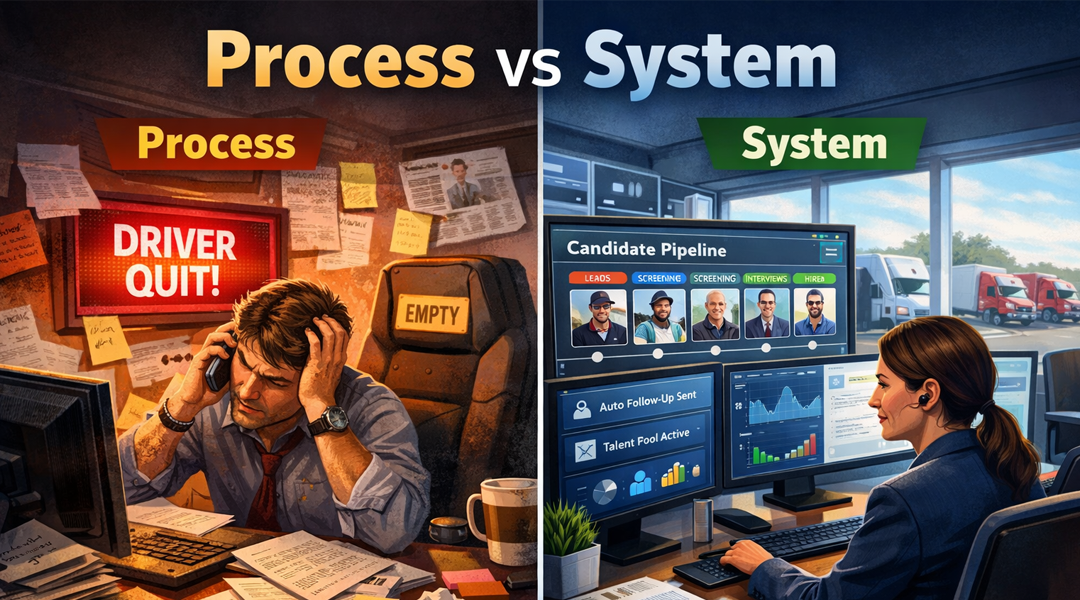
A recruiting process is reactive by nature. It exists to respond to a problem that has already happened. A driver gives notice, a seat goes empty, and the process kicks in. Post the job. Screen the applicants. Schedule the interviews. Make the offer. Onboard the hire.
There is nothing inherently wrong with having a process. You need one. But a process alone has a fundamental limitation: it only runs when something goes wrong.
Think about how most companies actually operate. The recruiter is busy when there are open seats and quiet when the roster is full. The job postings go up when there is urgency and come down when the position is filled. The outreach starts when there is a need and stops when that need is met.
That is a process. It is transactional. It is linear. And it is completely dependent on the assumption that when you need a driver, a qualified one will be available and ready to respond.
In today's market, that assumption is getting more dangerous every quarter.
What a System Actually Looks Like
A recruiting system does not wait for a problem to start working. It runs continuously, whether you have open seats or not. It is building something in the background every single day (awareness, relationships, pipeline, reputation) so that when a seat does open up, the response is not a scramble. It is a selection.
A system thinks in terms of flow, not transactions. Instead of asking "how do we fill this seat," it asks "how do we make sure we always have the right people ready to fill any seat." Those are fundamentally different questions, and they lead to fundamentally different strategies.
A recruiting system has a pipeline that is always warm. It has a presence in the market that is always visible. It has touchpoints with candidates that happen before those candidates are actively looking. It has data that tells you what is working and what is not, so you can improve over time instead of repeating the same mistakes under pressure.
Most importantly, a recruiting system does not live in one person's head. It does not disappear when your best recruiter takes a vacation or gives notice. It is documented, repeatable, and scalable in a way that a process almost never is.
The Moment Most Companies Realize the Difference
There is usually a specific moment when a transportation leader figures out they have a process and not a system. It tends to happen during one of three situations.
The first is when a key recruiter leaves. Suddenly the institutional knowledge walks out the door, the pipeline dries up overnight, and it becomes painfully clear that what looked like a system was really just one person doing a lot of things in their own way.
The second is when multiple seats open at the same time. A process that works fine for filling one position at a time completely falls apart when you need to hire several drivers quickly. There is no depth in the pipeline, no bench of warm candidates, no infrastructure to handle volume. The whole operation goes into crisis mode.
The third is when a competitor starts consistently outrecruiting you. They are hiring faster. They are getting better candidates. Their drivers are more stable. And when you look closely, the difference is not that they have more money or a bigger team. It is that they built something that compounds over time while you were filling seats one at a time.
What Has to Change
Making the shift from a process to a system is not about doing more things. It is about doing the right things consistently, even when there is no immediate pressure to do them.
It starts with pipeline thinking. A system requires that recruiting never fully stops, even when you are fully staffed. That means maintaining active candidate relationships, keeping your employer brand visible, and treating your talent pool like a living asset that needs ongoing attention rather than an emergency resource you tap in a crisis.
It requires measurement. A process runs on gut feel and urgency. A system runs on data. You need to know where your best hires are coming from, how long it takes to move candidates through each stage, where you are losing people, and what your cost per quality hire actually looks like. Without that data, you cannot improve. You can only react.
It also requires consistency in candidate experience. One of the biggest gaps between companies with strong recruiting and companies that struggle is how candidates are treated throughout the process. A system creates a reliable, professional, responsive experience every time, regardless of who is handling the interaction or how busy things are internally.
And it requires technology that actually supports all of the above. Not just a job board account or an applicant tracking spreadsheet, but tools that automate the repetitive work, keep candidates engaged, surface the right leads at the right time, and give you the visibility to make better decisions faster.
The Honest Question to Ask Yourself
Here is a straightforward way to figure out where you actually stand. If your top recruiter called out sick for two weeks starting tomorrow, what would happen to your pipeline?
If the answer is that things would slow down considerably or grind to a halt, you have a process. The recruiting in your organization is dependent on individual effort rather than structural design. And while individual effort matters, it is not something you can scale, replicate, or rely on when circumstances change.
If the answer is that the pipeline would keep moving because the outreach is automated, the leads are being worked, and the candidates are staying warm without anyone manually managing every step, then you are closer to a system.
Most companies, if they are honest, fall into the first category. They have people doing heroic work to keep hiring moving forward, and they have mistaken that heroic effort for infrastructure.
Building the System You Actually Need
You do not have to overhaul everything at once. Start by identifying the single biggest gap between what you have now and what a real system would look like.
For most companies, that gap is pipeline depth. The answer to that is committing to recruiting activity that happens independently of whether you have open seats. Reach out to silver-medal candidates from past searches. Create content that keeps your company visible to drivers who are not looking today but might be in three months. Build relationships with CDL programs and veteran transition organizations before you desperately need them.
From there, layer in measurement. Start tracking where your hires actually come from and where candidates fall out of your process. That data will tell you more about where to invest than any industry report.
The goal is to build something that gets stronger over time, not something that resets every time you fill a seat. That is the difference between a process and a system. And in a market that is only getting more competitive, it is a difference that is going to matter more than almost anything else.
HireMaster helps transportation companies move from reactive processes to proactive recruiting systems powered by AI. If you are ready to stop scrambling and start building, let's talk.

The Online Reputation Problem: What Drivers Are Reading About You (And Why It's Costing You Hires)

Behind the Curtain: What a Digital Strategist Actually Does for Your Campaigns