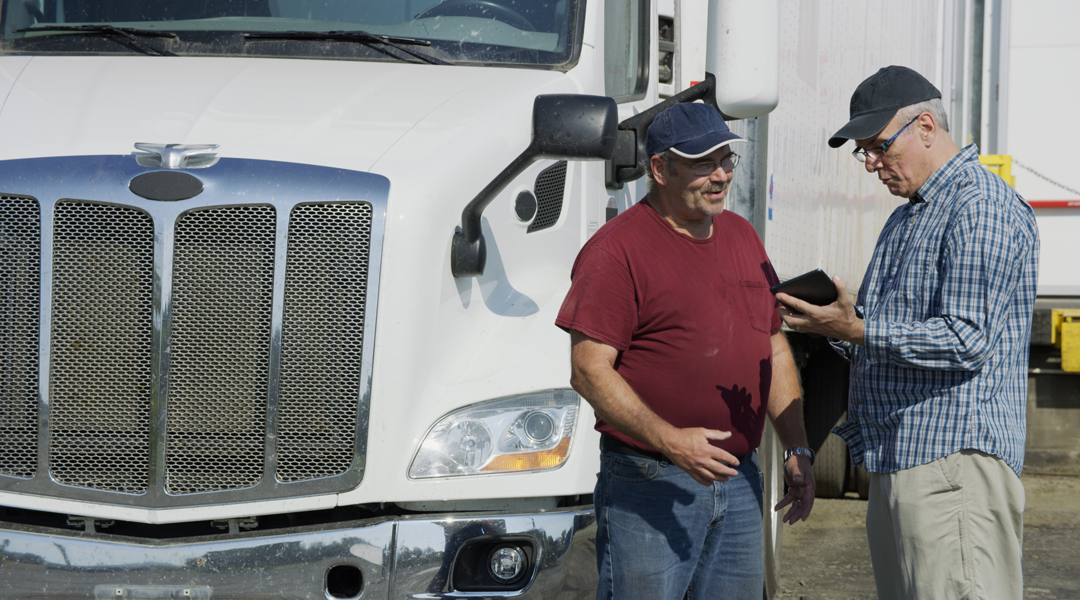
What Does a Trucking Company Look Like When AI Handles the Administrative Work?

What Does a Trucking Company Look Like When AI Handles the Administrative Work?
Think about how much time employees at a trucking company spend doing work that doesn't necessarily require their experience or judgment.
Recruiters spend hours following up with applicants, answering the same questions, and coordinating interviews. Dispatchers manage constant communication about appointments, delays, and delivery updates. Safety departments track documentation, monitor compliance requirements, and remind drivers about missing paperwork.
Each task serves a purpose, but collectively, they consume a significant amount of time across an organization.
Now imagine a trucking company where much of that repetitive administrative work happens automatically.
Driver questions receive immediate responses. Recruiting follow-ups happen without someone manually sending every message. Routine scheduling is coordinated in the background, and employees spend less time searching for information across multiple systems.
What would that trucking company look like, and how would the roles of its employees change?
Artificial intelligence is creating opportunities for transportation companies to rethink how work gets done. The biggest impact may not come from replacing employees, but from allowing experienced people to spend more time on the responsibilities that actually require their expertise.
The Administrative Work Nobody Really Notices
Transportation is an industry built around moving freight, but behind every truck on the road is a substantial amount of administrative activity.
Consider the average recruiter's day. A new application comes in, followed by a phone call, a voicemail, and several attempts to reconnect with the candidate. Meanwhile, other applicants need qualification questions answered, interviews scheduled, and updates on where they stand in the hiring process.
Dispatchers face a different version of the same challenge. Drivers need information, customers request updates, and routine scheduling changes require communication between multiple parties. Safety teams deal with documentation, compliance reminders, and administrative follow-ups that must be completed accurately and on time.
None of these responsibilities can simply be ignored. But not every interaction requires someone to stop what they're doing and handle it personally.
That's where automation has the potential to make a meaningful difference.
Rather than having employees initiate every routine message, locate every document, or manually coordinate every appointment, AI-enabled systems can assist with repetitive workflows and help direct more complicated situations to the appropriate person.
The result isn't necessarily fewer responsibilities. It's an opportunity to manage those responsibilities more efficiently.
What Changes for Recruiters, Dispatchers, and Safety Teams?
For recruiting departments, one of the most immediate opportunities involves candidate communication.
A driver might apply for a position after business hours, when no recruiter is available to respond. By the following morning, that driver may have already spoken with another carrier. Automated engagement can help fleets respond sooner, answer initial questions, gather qualification information, and keep candidates moving through the process.
At HireMaster, this is one of the areas where Ashli.ai, our AI Recruiting Assistant, helps transportation companies. Ashli can engage interested drivers, answer questions about available positions, assist with initial qualification, follow up with candidates, and help schedule conversations directly on recruiters' calendars.
Instead of spending much of their day attempting to contact applicants, recruiters can focus more attention on conversations with drivers who are interested and ready to move forward.
Dispatch operations present a different opportunity. AI-assisted systems could help handle routine status requests, organize appointment information, and identify situations that require a dispatcher's attention. That could give dispatchers more time to manage exceptions, solve problems, and maintain relationships with drivers and customers.
Safety departments could also benefit from tools that organize documentation, identify missing information, and assist with routine reminders. Of course, regulatory decisions, compliance oversight, and safety-sensitive judgments still require qualified personnel and appropriate verification.
Across these departments, the opportunity is similar: reduce the time spent managing repetitive tasks so employees can concentrate on decisions, relationships, and problems that require human experience.
The Real Opportunity Is What Employees Can Do With Their Time
It's easy to evaluate automation by counting how many minutes it saves. But time savings alone don't tell the whole story.
Consider a recruiter who spends several hours each day making initial contact attempts and coordinating schedules. If technology can handle a meaningful portion of those activities, that recruiter may have more time to speak with qualified drivers, understand their concerns, and help them make informed decisions about joining the company.
The same principle applies to dispatchers. Less time answering repetitive status questions could mean more time addressing unexpected delays, supporting drivers, and finding solutions when operations don't go according to plan.
For safety managers, reducing administrative follow-ups could create more opportunities to focus on training, coaching, and identifying potential risks before they become larger problems.
These are responsibilities where employee experience and judgment can make a difference.
The goal shouldn't be to automate every possible interaction. It should be to identify where technology can handle routine work reliably and where employees provide the greatest value.
That distinction matters because trucking is still a relationship-driven business. Drivers want to know they can reach someone when something goes wrong. Customers expect accountability, and complicated operational decisions often require context that an automated system may not fully understand.
Technology works best when it supports those relationships rather than creating barriers between people.
Automation Won't Fix a Broken Process
There's an important challenge transportation companies should consider before introducing more AI into their operations.
Automating an inefficient process doesn't automatically make it a good process.
If recruiting information is inaccurate, an automated system may communicate the wrong details to candidates. If scheduling information isn't updated, automation could create confusion instead of reducing it. And if departments operate with disconnected systems, introducing another technology platform may simply add complexity.
Successful automation starts with understanding how work currently moves through the organization.
Which tasks are repetitive? Where do employees spend time transferring information between systems? What causes delays? And which decisions genuinely require a person?
For some fleets, the greatest opportunity may be improving candidate follow-up. For others, it could be reducing administrative paperwork or making operational information easier to access.
Starting with a specific problem also makes it easier to evaluate whether the technology is producing meaningful results.
In recruiting, for example, fleets can look beyond the number of automated messages sent and examine whether candidates are being contacted more consistently, qualification information is being collected, and more interested drivers are reaching meaningful conversations with recruiters.
Those outcomes matter more than automation for its own sake.
The Trucking Company of Tomorrow May Look Familiar, but Work Differently
A trucking company that uses AI effectively may not look dramatically different from the outside.
Trucks will still need drivers. Dispatchers will still coordinate freight. Safety teams will still oversee compliance, and recruiters will still help companies find the people needed to keep equipment moving.
What changes is how much of the routine work surrounding those responsibilities requires manual attention.
Instead of beginning every morning with a long list of unanswered applicant messages, a recruiter could arrive to find qualified drivers already scheduled for conversations. A dispatcher might spend less time locating routine updates and more time addressing situations that need immediate attention. Safety teams could have better visibility into outstanding documentation without manually reviewing every record.
Not every one of these capabilities is available or appropriate for every fleet today. Implementing them also requires reliable data, integration with existing systems, human oversight, and careful attention to privacy and compliance.
But the direction is worth considering.
At HireMaster, we're already helping transportation companies apply this approach to recruiting through Ashli.ai. By automating portions of candidate engagement, qualification, follow-up, and scheduling, fleets can give recruiters more opportunities to focus on the people behind the applications.
And as similar capabilities develop across other areas of transportation, the larger opportunity becomes clear.
The future of trucking may not be about having AI do everyone's job. It may be about giving employees more time to do the parts of their jobs that matter most.
For fleet leaders, the question is no longer simply whether AI belongs in transportation. It's where automation can remove unnecessary administrative work while making the people running the operation more effective. To learn more about automation and enhancing your teams workflow to hire drivers, reach out to our team today!

The Biggest Mistakes Fleets Make When Recruiting Drivers

Creating Opportunities for Gen Z and High School Graduates in Transportation