
Your Competitor Isn’t Outspending You. Their Job Is Outperforming Yours.
Your Competitor Isn’t Outspending You. Their Job Is Outperforming Yours.
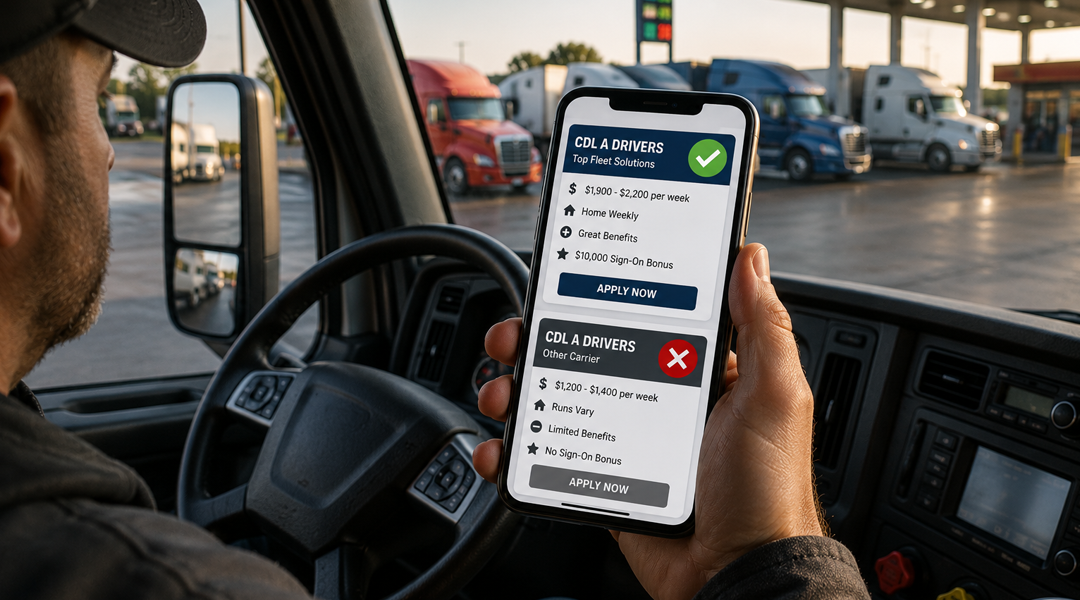
Two fleets are recruiting drivers in the same market. They’re spending roughly the same amount on advertising, using many of the same job boards, competing on the same searches, and trying to reach the same pool of qualified CDL drivers.
But one fleet is generating more applicants, filling trucks faster, and seemingly having a much easier time recruiting.
The natural reaction is to look at the advertising. Maybe their campaigns are better. Maybe they’ve found a better source. Maybe their recruiters are doing something differently.
Sometimes that’s true. But there’s another explanation that fleets can easily overlook.
Their job may simply be more competitive than yours.
At some point, recruiting comes down to the opportunity being offered. You can have great advertising, experienced recruiters, strong technology, and a healthy recruiting budget, but drivers still get to decide which job deserves their attention.
Same Market, Same Drivers, Different Results
Imagine two carriers trying to hire experienced CDL-A drivers within the same 50-mile radius. Both are investing similar amounts each month. Both advertise across major job boards and search engines, and both have recruiters actively working candidates.
One consistently generates applications and fills openings. The other struggles.
Now compare the actual jobs.
One offers competitive weekly earnings, predictable home time, newer equipment, consistent miles, and a schedule drivers in that market want. The other asks drivers to stay out longer, offers lower expected earnings, or has a schedule that’s simply less attractive.
Both companies can put their opportunity in front of the exact same driver. But advertising only gets the jobs onto the same screen.
The driver still decides which one gets the application.
That’s why a job should be thought of almost like a product. Fleets aren't simply trying to reach drivers. They're taking an opportunity to market and asking someone to choose it over all the alternatives available to them.
A Good Job Isn’t Always a Competitive Job
This is an important distinction.
Leadership may believe the compensation is fair. The home-time policy may have worked for years. The benefits might be solid, and there may be plenty of current drivers who are happy with the position.
That can all be true while the job becomes increasingly difficult to recruit for.
Drivers don't evaluate your opportunity in isolation. They're comparing it with everything else they can find.
An $85,000 earning opportunity might look attractive until another carrier nearby offers $90,000 with better home time. Being home every other weekend might have been competitive in the past, but it becomes harder to sell if several fleets in the market are advertising weekly home time.
And compensation isn't everything. Equipment, schedules, freight type, benefits, guaranteed pay, miles, touch versus no-touch freight, and company reputation can all influence the decision.
A fleet doesn't necessarily need to pay the most or offer the easiest job. But there has to be enough value somewhere in the package to make the opportunity worth choosing.
Your Recruiting Results Are Telling You Something
When applicant volume falls or cost per hire increases, it's easy to view it entirely as a marketing problem.
Sometimes it is.
But recruiting performance can also be feedback from the labor market.
If drivers are seeing your job but aren't clicking, that's information. If they're applying but repeatedly declining after learning more about the opportunity, that's information too. And if recruiters keep hearing the same objections about pay, home time, schedules, equipment, or another part of the job, those conversations shouldn't be dismissed as candidates being difficult.
The market may be telling you exactly where your job isn't competing.
This is also why cost per applicant shouldn't always be viewed strictly as an advertising metric. Two fleets can pay to reach the same driver, but if one has a more attractive opportunity, it's naturally going to have an easier time converting that attention into an application.
Over thousands of impressions, those individual decisions add up.
One fleet may ultimately have to spend significantly more advertising dollars to produce the same number of applicants because it's using media to compensate for a weaker offer.
More Advertising Won’t Fix Everything
This is where recruiting can become expensive.
Hiring falls behind, so the advertising budget increases. Another job board gets added. New ads are created. Recruiters work the leads harder. Headlines change, landing pages are adjusted, and eventually leadership starts asking why the additional investment isn't producing enough hires.
All of those changes can improve performance when recruiting is actually the problem.
But they don't change the job.
If drivers don't like the schedule, another $5,000 in advertising doesn't change the schedule. If compensation is below comparable opportunities, a better ad doesn't change the paycheck. If candidates want weekly home time and the position requires three weeks out, changing the headline doesn't eliminate that tradeoff.
At some point, you're no longer spending money to improve recruiting. You're spending money to overcome the offer.
And there's a limit to how effectively you can do that.
Your Recruiters Are Doing Market Research Every Day
Before increasing the budget again, talk to the people speaking with drivers.
Your recruiters probably already know which jobs are easy to sell and which ones require significantly more effort. More importantly, they know why.
"I'm making more than that now."
"I need to be home more often."
"Another carrier offered me guaranteed pay."
"I don't want that type of freight."
One objection doesn't mean the job needs to change. No opportunity is going to appeal to every driver.
But when qualified candidates keep giving you the same answer, that's no longer just an objection. It's a pattern.
Recruiters are talking directly to the workforce you're trying to attract every day. That makes their conversations a valuable source of market intelligence. Instead of always asking them to overcome the objection, sometimes leadership needs to ask what's creating it.
Know What You’re Actually Competing Against
Fleets often look at competitors from an advertising perspective. Where are they posting? Which job boards are they using? Are they advertising on Google or social media? How much visibility do they have?
Those questions matter, but they only tell you part of the story.
The bigger question is: What are they actually offering?
Look at compensation, home time, schedules, freight, equipment, benefits, bonuses, guarantees, experience requirements, and the way those benefits are being communicated.
Then look at the recruiting investment behind those jobs.
If a competitor is winning, maybe they really are outspending you. Maybe they're simply creating more visibility and reaching more drivers.
But what if they're spending roughly the same amount?
Now the conversation becomes much more interesting.
If two companies are investing similar amounts, competing for the same drivers in the same market, and one consistently produces significantly better results, the difference may be the job itself.
How HireMaster Helps Find the Answer
At HireMaster, we don't believe every recruiting problem should be solved by simply buying more advertising.
Our platform can help fleets improve job distribution, optimize advertising, engage candidates through Ashli, automate follow-up, and understand what's happening throughout the recruiting process. Those capabilities help make sure recruiting dollars are being used effectively and qualified candidates aren't being lost because of gaps in engagement or follow-up.
But sometimes we need to look deeper.
HireMaster can conduct detailed market and competitive research to help fleets understand exactly what they're up against. We can look at who else is hiring drivers in a market, what types of jobs they're advertising, what compensation and home-time packages they're promoting, how their positions compare with yours, and how recruiting investment differs across the competitive landscape.
Putting those pieces together helps answer the question that matters most: Why are they winning?
Maybe the competitor is simply spending more. Maybe your job is competitive, but candidates are being lost somewhere in the recruiting process. Maybe the market itself has become more difficult.
Or maybe competitors are offering drivers something you aren't.
Each of those problems requires a completely different response.
That's why understanding the market before simply increasing the recruiting budget can be so valuable. Sometimes the answer is better advertising. Sometimes it's better candidate engagement. Sometimes it's a different budget or sourcing strategy.
And sometimes the research shows that the job itself needs another look.
Transportation Leader Takeaway
When a competitor is consistently beating you for drivers, don't immediately assume they've discovered a recruiting strategy you haven't.
Start by comparing the entire picture.
Are you competing in the same market? Reaching the same drivers? Spending similar amounts? What are they offering that you aren't? And what are candidates telling your recruiters when they choose another opportunity?
Recruiting can create awareness. Great recruiters can build relationships. Technology can improve engagement, and better data can help you make smarter decisions.
But ultimately, drivers still choose the job.
If your competitor is winning the recruiting battle with similar resources, they may not have better advertising. They may simply have a better job to advertise. Talk to our team today, to get intel on your competitors and make your job a win with drivers!
The Difference Between a Recruiting Process and a Recruiting System
.jpg)
HireMaster.Ai Announces Integration with Greenhouse to Streamline Hiring and Improve Candidate Experience
